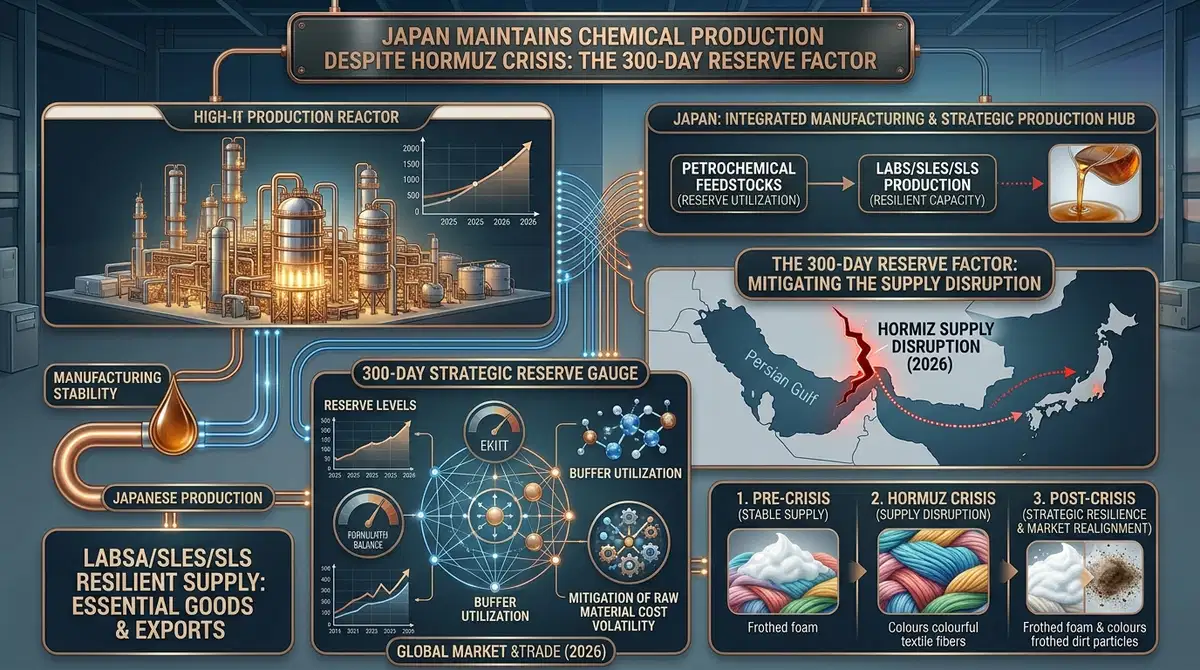
Japan Maintains Chemical Production Despite Hormuz Crisis: The 300-Day Reserve Factor
Overview
When the Strait of Hormuz faced major disruptions in late February 2026, many Asian economies feared severe supply shortages of crude oil and petrochemical feedstocks. Japan, however, was able to avoid an immediate production crisis thanks to its approximately 300 days of strategic oil reserves, the largest stockpile among major Asian economies. These reserves provided a crucial buffer, allowing chemical producers to continue operating while global energy and petrochemical markets adjusted.
The Importance of Japan's Strategic Reserves
Japan's extensive energy security policy has long emphasized maintaining large emergency petroleum reserves. During the Hormuz disruption, these reserves helped:
Stabilize domestic energy supply.
Prevent sudden feedstock shortages.
Reduce panic buying in industrial markets.
Support continued operation of chemical facilities.
Provide time for alternative supply routes to develop.
As a result, Japan experienced less immediate disruption than many import-dependent economies.
Impact on the Petrochemical Industry
Although strategic reserves prevented a full-scale production crisis, Japan's petrochemical sector was not immune to market pressures.
Key challenges included:
Higher feedstock costs.
Increased shipping and insurance expenses.
Reduced profitability for commodity chemical producers.
Supply chain uncertainty across Asia.
Temporary operational disruptions at some facilities.
Several Japanese and South Korean chemical companies declared force majeure during March 2026 as logistics and raw material availability became increasingly uncertain. However, many facilities later resumed operations at reduced production rates as supply chains stabilized.
Accelerating Industry Consolidation
The crisis has intensified an existing trend toward consolidation within Japan's petrochemical industry.
Factors driving consolidation include:
Aging production assets.
Rising energy costs.
Global competition from lower-cost producers.
Pressure to improve operational efficiency.
Growing focus on higher-value specialty chemicals.
As a result, companies are increasingly evaluating plant closures, asset optimization, and strategic partnerships to remain competitive.
Why Specialty Chemicals Are More Resilient
Japan's chemical industry is globally recognized for its leadership in high-value specialty chemicals.
Major specialty segments include:
Semiconductor process chemicals
Electronics materials
High-purity solvents
Specialty adhesives
Fine chemicals
Advanced functional materials
Unlike commodity petrochemicals, these products generate significantly higher value from relatively small volumes of feedstocks. Consequently, raw material cost increases have a smaller impact on overall profitability.
Beneficiaries of the Supply Shift
Japan's specialty chemical producers have benefited from demand shifting away from disrupted Middle Eastern supply chains.
Products experiencing strong demand include:
High-purity Isopropyl Alcohol (IPA)
Semiconductor-grade chemicals
Electronics manufacturing materials
Specialty adhesives
Advanced cleaning and processing chemicals
These products remain essential to industries such as semiconductor manufacturing, electronics, automotive technology, and precision engineering.
Semiconductor Supply Chain Advantage
Japan plays a critical role in the global semiconductor ecosystem through the production of highly specialized materials and process chemicals.
Strengths include:
High purity standards
Advanced manufacturing expertise
Reliable quality control
Strong research and development capabilities
Long-standing relationships with global chipmakers
Because semiconductor chemicals represent a small portion of overall manufacturing costs but are essential for production, demand has remained resilient despite broader market volatility.
Outlook
Japan's substantial oil reserves have demonstrated the importance of energy security during geopolitical disruptions. While the Hormuz crisis has increased costs and accelerated restructuring within commodity petrochemicals, Japan's specialty chemical sector remains well-positioned to benefit from global demand for advanced materials, semiconductor chemicals, and high-performance industrial products.
Glacial Acetic Acid (99,8%) - India CAS: 64-19-7
Key Takeaways
Japan's 300-day oil reserve prevented an immediate chemical production crisis during the 2026 Hormuz disruption.
Commodity petrochemical producers faced higher costs and operational challenges.
Industry consolidation is accelerating across Japan's petrochemical sector.
Specialty chemicals are more resilient due to lower feedstock intensity and higher product value.
High-purity IPA, semiconductor chemicals, and specialty adhesives continue to see strong demand.
Japan remains a critical supplier of advanced materials to the global electronics and semiconductor industries.