

For decades, industrial solvents have been dominated by petroleum-derived products such as xylene, toluene, mineral spirits, methyl ethyl ketone and various acetate solvents. These materials became industry standards because they delivered strong performance at competitive costs and were supported by mature global supply chains.
Today, however, the market is changing.
Environmental regulations targeting volatile organic compound (VOC) emissions, combined with corporate sustainability commitments and carbon reduction goals, are creating new opportunities for renewable solvent technologies. While many bio-based chemical concepts have struggled to scale commercially, bio-solvents are emerging as one of the few categories demonstrating meaningful market adoption.
The transition is still in its early stages, but several renewable solvent technologies have already moved beyond pilot projects and into real industrial use.
Why the Solvent Market Is Changing
Traditional solvents face increasing scrutiny from regulators and customers alike.
Key market drivers include:
VOC emission regulations.
Corporate sustainability programs.
Carbon footprint reduction targets.
Green procurement initiatives.
Consumer demand for environmentally responsible products.
These pressures are encouraging manufacturers to evaluate alternatives that can reduce environmental impact without sacrificing performance.
For many applications, bio-based solvents are becoming increasingly viable options.
What Makes a Solvent "Bio-Based"?
A bio-based solvent is derived wholly or partially from renewable feedstocks rather than fossil resources.
Common feedstocks include:
Corn.
Sugarcane.
Soybeans.
Agricultural waste streams.
Forestry by-products.
Vegetable oils.
Through fermentation, extraction or chemical conversion processes, these feedstocks can be transformed into solvents suitable for industrial use.
The goal is not simply replacing petroleum but creating products that offer competitive performance while improving sustainability metrics.
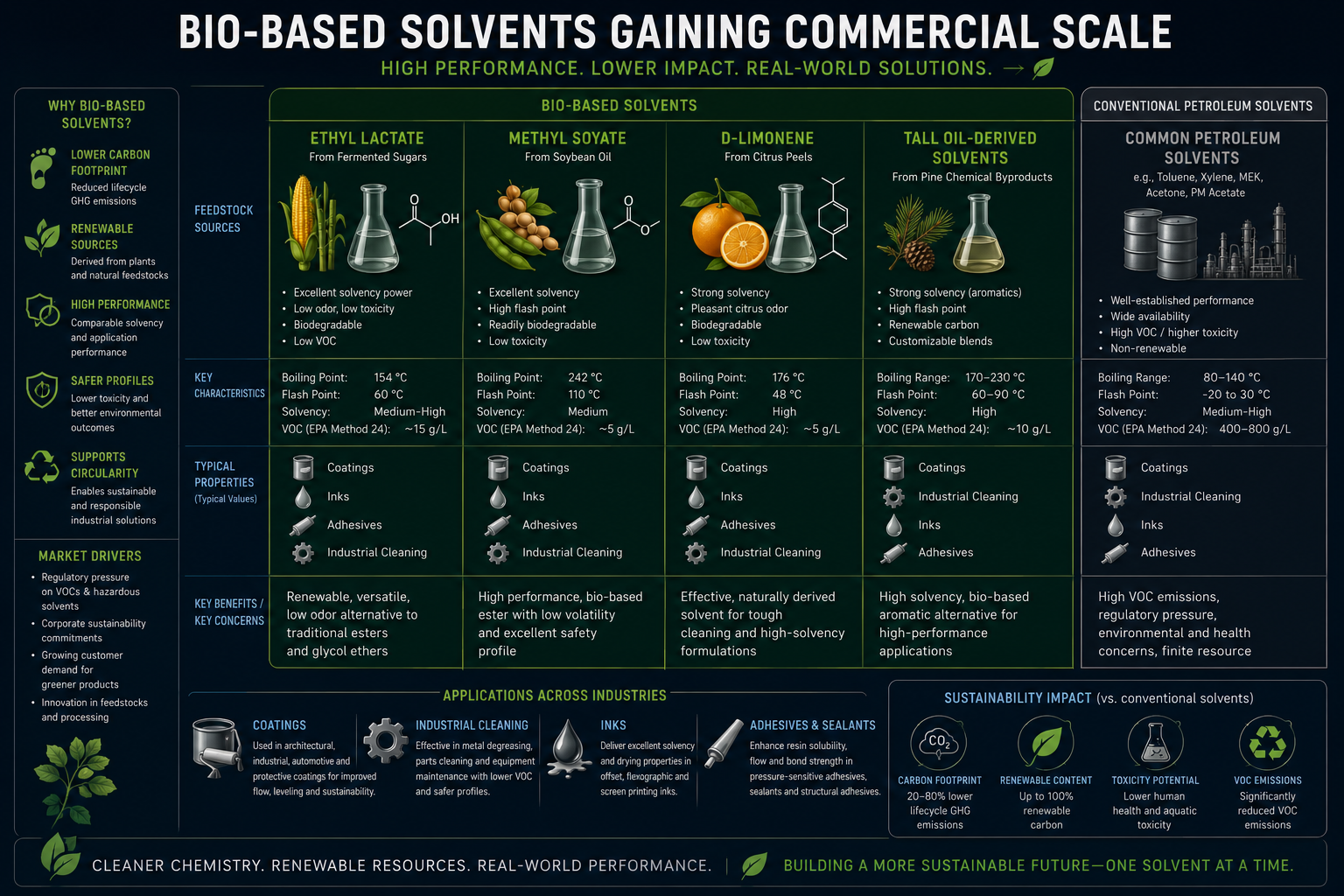
Which Bio-Based Solvents Are Actually Scaling?
Several categories have achieved meaningful commercial adoption.
Ethyl Lactate
Produced from fermentation-derived lactic acid, ethyl lactate has become one of the most widely recognized bio-based solvents.
Applications include:
Industrial cleaning.
Electronics cleaning.
Specialty coatings.
Printing inks.
Its strong solvency profile and favorable environmental characteristics have supported commercial growth.
Methyl Soyate
Derived from soybean oil, methyl soyate is increasingly used in:
Industrial degreasers.
Asphalt release agents.
Agricultural formulations.
Cleaning products.
Its low toxicity and renewable origin make it attractive in environmentally sensitive applications.
d-Limonene
Recovered from citrus processing by-products, d-limonene has found applications in:
Cleaning products.
Adhesive removal.
Consumer formulations.
Industrial degreasing.
The product benefits from both renewable sourcing and strong consumer acceptance.
Tall Oil-Based Solvents
Derived from forestry by-products, tall oil-based chemistries continue gaining attention as renewable alternatives for selected industrial applications.
These products align particularly well with sustainability initiatives focused on circular economy principles.
Performance Has Improved Significantly
Historically, many bio-based solvents struggled to compete with conventional alternatives.
Modern formulations have narrowed that gap considerably.
Many commercially successful bio-solvents now offer:
Strong solvency performance.
Low toxicity profiles.
Reduced VOC emissions.
Improved biodegradability.
Enhanced worker safety characteristics.
However, performance remains application-specific.
In some high-performance industrial environments, conventional solvents still maintain advantages in evaporation rate, compatibility or cost.
Cost Remains the Biggest Challenge
Despite technological improvements, economics remain one of the largest barriers to broader adoption.
Bio-based solvents often face:
Higher feedstock costs.
Smaller production scales.
More complex supply chains.
Limited manufacturing capacity.
As a result, pricing frequently exceeds that of conventional petrochemical solvents.
However, many buyers increasingly evaluate total value rather than purchase price alone.
Additional considerations include:
Regulatory compliance costs.
Sustainability reporting requirements.
Worker safety benefits.
Environmental performance.
These factors can help justify higher initial material costs.
Industrial Cleaning Is Leading Adoption
Among all application segments, industrial cleaning has emerged as one of the strongest markets for bio-based solvents.
Manufacturers are increasingly adopting renewable solvents because:
Performance requirements are achievable.
Regulatory pressure is significant.
Worker exposure concerns are important.
Sustainability benefits are easily communicated.
As a result, cleaning products remain one of the fastest-growing demand categories.
Coatings and Inks Are Following Closely Behind
The coatings and printing industries are also becoming important growth areas.
VOC regulations continue encouraging manufacturers to explore:
Waterborne formulations.
Low-VOC systems.
Renewable solvent blends.
Sustainable coating technologies.
Although bio-based solvents are unlikely to completely replace conventional solvent systems in the near term, they are becoming increasingly common in specialty formulations.
Sustainability Reporting Is Becoming a Procurement Driver
A major shift occurring in 2026 is the integration of sustainability metrics into purchasing decisions.
Procurement teams increasingly evaluate:
Renewable content.
Carbon footprint.
Feedstock traceability.
Regulatory exposure.
Scope 3 emissions.
Bio-based solvents often perform favorably across these criteria, creating additional demand beyond simple technical performance considerations.
What Buyers Should Watch Through 2030
The next phase of growth will likely depend on several factors:
Expansion of renewable feedstock supply.
Production capacity growth.
VOC regulatory developments.
Corporate decarbonization programs.
Improvements in solvent performance.
Cost competitiveness versus petrochemical alternatives.
Technologies that can deliver both environmental benefits and economic value will likely achieve the strongest adoption.
The Bottom Line
Bio-based solvents have moved beyond the experimental stage and are becoming one of the clearest success stories in green chemistry. Products such as ethyl lactate, methyl soyate, d-limonene and tall oil-derived solvents are demonstrating that renewable alternatives can achieve meaningful commercial adoption when performance, economics and sustainability objectives align.
While conventional petroleum-based solvents will continue to dominate many industrial applications, the direction of travel is increasingly clear. Regulatory pressure, sustainability commitments and evolving procurement priorities are creating long-term opportunities for renewable solvent technologies.
For suppliers, the challenge is scaling production efficiently. For buyers, the opportunity is identifying where bio-based solvents can deliver both environmental and operational value. The companies that successfully navigate this transition will be well positioned as sustainable chemistry becomes a larger part of industrial procurement strategies.
Interested in sourcing renewable solvents and sustainable chemical solutions? Explore verified suppliers and emerging market opportunities on our platform today.
2-Ethyl Hexanol CAS: 104-76-7